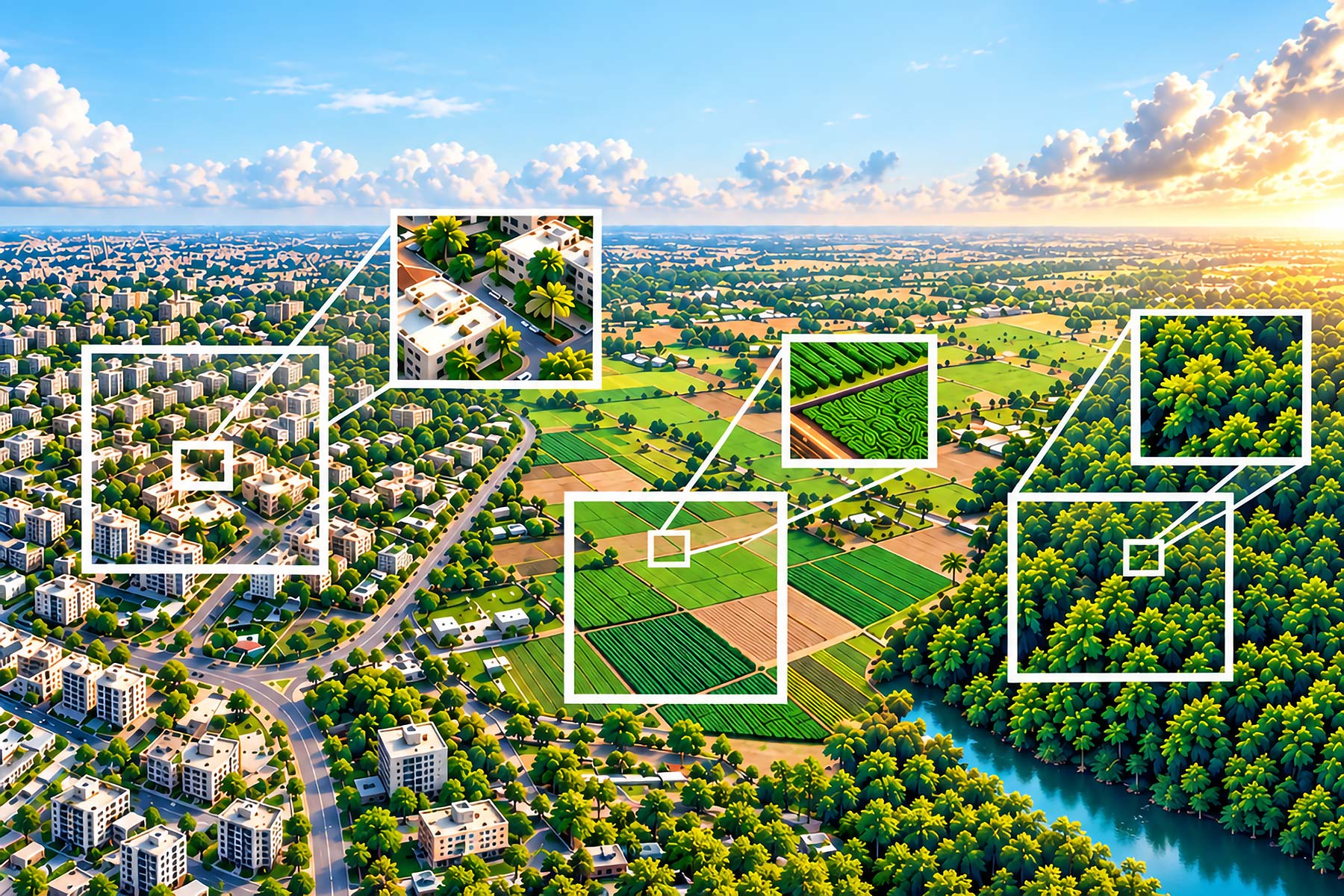
Dr. Nejib Ben Hadj-Alouane, Professor of Computer Engineering and Program Director of the Master of Science in Artificial Intelligence (MSAI) at the American University in Dubai (AUD), co-authored a study advancing AI-based recognition of aerial scenes with researchers from institutions in Saudi Arabia, Pakistan, Lithuania, and South Korea. The study, “A Novel Multi-Scale Feature Fusion with Adaptive Scale-Space Pyramid Network for Aerial Scene Recognition Using Remote Sensing Images,” was published in the IEEE Journal of Selected Topics in Applied Earth Observations and Remote Sensing.
Recognizing landscapes in remote sensing images presents several challenges. Objects appear at different scales, scene categories can look similar, and complex environments contain many competing visual details.
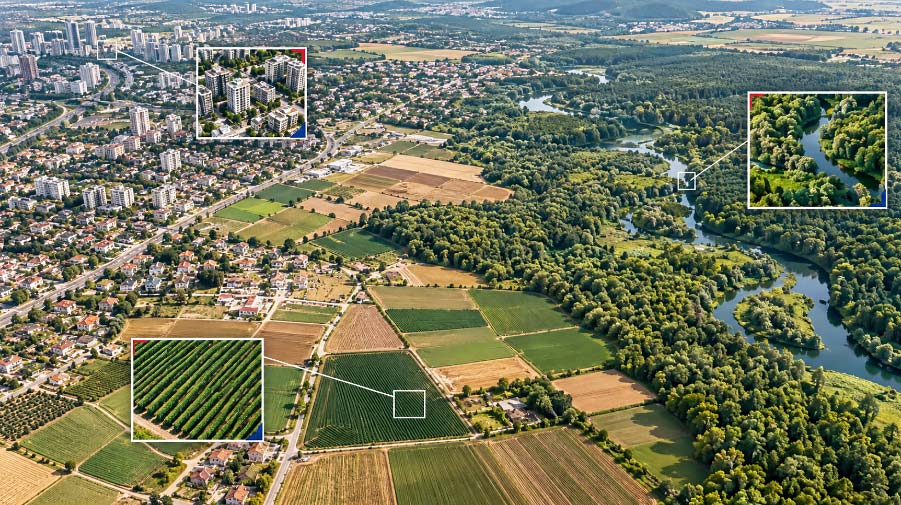
The study introduces an adaptive AI model that combines fine image details with broader scene patterns. Using attention mechanisms, which direct the model to the most relevant parts of an image, the model selects and combines information at different scales to classify scenes such as urban areas, forests, and farmland.
The researchers evaluated the approach on three benchmark datasets, reporting classification accuracies of 96.14% on EuroSAT, 94.73% on NWPU-RESISC45, and 95.42% on MLRSNet.
In the reported experiments, the approach outperformed the established image recognition models it was compared against. Such advances in remote sensing image analysis could support applications including land-use planning and environmental monitoring.
Dr. Ben Hadj-Alouane leads AUD's MSAI program, which covers artificial intelligence and machine learning, with electives in areas including computer vision and deep learning, alongside a thesis component.
Read the research paper: doi.org/10.1109/JSTARS.2026.3651659
Learn more about AUD's MSAI program here